I went several years without writing short stories.
My first publication was actually a short story about a conscientious objector that I wrote when I was 17, which ended up being anthologised in a small Australian fiction collection. I wrote a few more stories after that around 2015 and 2016, two of which had a memoir/comedy slant, which also appeared in print. However, following this period, I fell out of love with the form. I wanted to write short fiction that would meet the standards of Australian literary journals, both as a goal to help me improve my writing practice, and also simply as a result of the somewhat insecure, personal desire to feel accepted by other writers and their platforms! Yet much of the short fiction being published in Australian literary journals at the time had a grungy aesthetic, capturing a particular brand of Sydney/Melbourne realism which was accomplished in many ways, but which also didn’t resonate much with me. Plenty of these stories – as I recall them – revolved around disenchanted youth, drugs, violence, urban decay, and misery. All rich themes in and of themselves, but the homogeneity of the tone common to many of these stories, and the emphasis on emotional detachment throughout them, eventually left me cold. I began to feel that my short stories were naive and – to put it bluntly – not ‘edgy’ enough. To be fair, my short stories were also often simply bad, and in many ways still are. Anyway – the consequence of this disenchantment was that I shifted my focus to improving my nonfiction and poetry skills, and barely wrote any short fiction between 2018 and 2024.
After branching out recently and reading a wider range of short fiction, however – such as stories by Ken Liu, Clarice Lispector, Tove Jansson, and others – I’ve begun to feel newly inspired about the form’s possibilities, and keen to improve my short fiction writing skills.
To this end, in 2024, I tried my hand at speculative fiction and wrote a short story inspired by ‘smog-eating’ paint, composed of a graphene-titania composite, which is in fact a real-life emerging technology that I encountered during my work as a research communicator for a Cambridge physics lab.
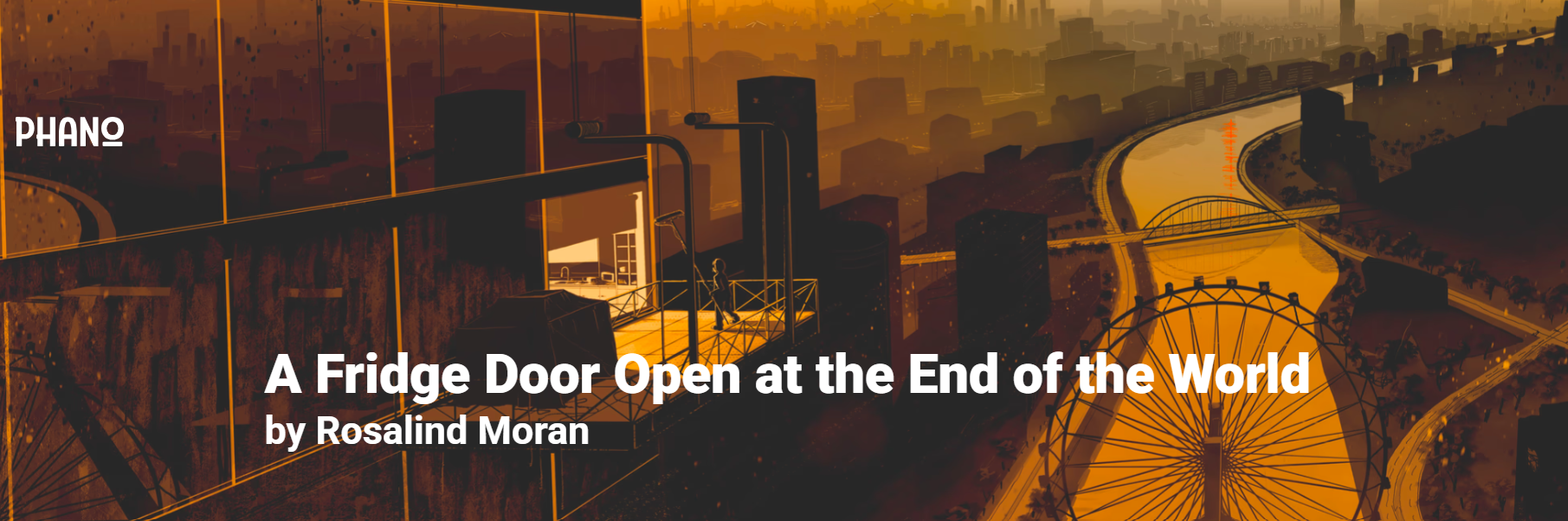
The resulting story, A Fridge Door Open at the End of the World, is not perfect, but I’m still overall quite pleased with it. It was fun to write. If you are interested in reading it, it has been published in Issue 2 of literary fiction magazine Phano. You can find it here.
